$105,000 Ohio Verdict Shows What Happens When OEM Repair Procedures Are Ignored
An Ohio appellate court decision upholding a $105,000-plus judgment against a Columbus-area collision shop should be required reading for every body shop owner in the country. The case — Jeremy Williams v. Sharron Woods Collision Center — documents what happens when a shop ignores OEM repair procedures, performs structurally deficient work, bills for operations it never completed, and then gets caught by three independent expert witnesses.
The shop involved no longer operates under the same ownership, and all references throughout this account relate to the facility under prior owner Bernie Burckard, not today's Sora's Sharon Woods.
Background
Williams brought a 2010 Nissan Maxima to Sharon Woods Collision in 2012 for a repair. When the quality of the work was subsequently challenged, he sued in 2014. The jury awarded damages of $8,079.78. Hamilton County Court of Common Pleas Judge Mark Schweikert then granted treble damages, attorney fees, and costs — bringing the total judgment to $105,462.59.
The shop sought a new trial twice and appealed once. The Ohio First District Appellate Court upheld the judgment in 2018.
Larry Montanez, who testified as an expert witness for the plaintiff, described the repair simply: "a very crappy repair." He also stressed that the insurer covering the original repair "had nothing to do" with the problems found.
What Was Actually Wrong With the Car
Three expert witnesses — Montanez, Mike Anderson, and David Williams — all testified that the Maxima had not been repaired in accordance with Nissan's specifications or I-CAR guidelines. Their findings were specific and technically detailed.
Structural Adhesive Used Without Authorization
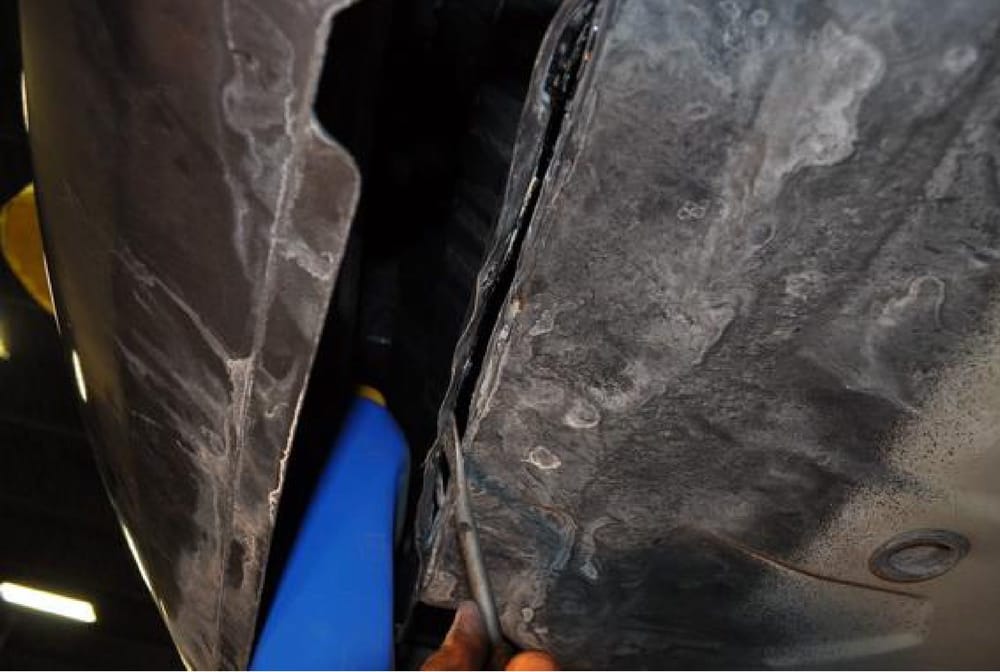
The most significant structural finding involved the rear body panel. Sharon Woods Collision used structural adhesive to bond panels to the vehicle — a method that Nissan had not approved. More critically, the adhesive didn't just fail to meet specifications: it failed literally.
Montanez was able to separate the rear body panel from the vehicle using a small ball-peen hammer and a gasket scraper. The adhesive was still wet and sticky — similar in consistency to butyl tape. He was able to create a gap wide enough to fit an antifreeze bottle between the floor pan and rear body panel.
"It just literally came apart," he said.
The technical analysis he submitted to the court noted: "Destructive testing of the center lower rear body panel to trunk floor panel mating flange required lightly applied pressure to separate the entire flange. No evidence of MAG or STRSW were observed to the area and there were indications of adhesion failure to the rear body panel mating flange."
For context: structural adhesive requires temperatures of 350–400°F to soften the bond enough to permit separation. No heat was needed here.
The shop's defense argued that adhesive bonding, while not specified by Nissan, was not explicitly prohibited and was used in the industry for corrosion protection. Judge Schweikert was not persuaded. The vehicle was returned to the customer "in an unsafe condition."
Weld Quality
The welds on the rear body panel were severely deficient. MAG plug welds must pull a nugget hole of 8–10 mm to meet specifications. Montanez's destructive testing pulled only a 3–4 mm nugget hole. The welds were also in incorrect locations and were the wrong type.
Wrong Seam Sealer
The trunk area and rear body panel showed evidence of sprayable seam sealer — the type used for undercarriage applications — applied where Nissan specifications required brushable or pumpable seam sealer. Sprayable seam sealer was also found in the spare tire well, which should have had sound dampening pads installed per Nissan procedure. The seam sealer that was applied had not been refinished.
Gap and Fit Issues
Panel gaps throughout the vehicle were significantly out of tolerance. The hood-to-bumper fascia gap measured 11mm on the left, 14mm in the center, and 7mm on the right. Nissan specifications call for a 4–6mm gap.
The cause was traced to worn lower rocker panel mounting clips that allowed 10–12mm of movement in the front fascia. Multiple plastic retaining clips were also in need of replacement.
At the rear, tail lamp gaps to the quarter panels measured 5–6mm; the specified tolerance is 1–2mm. Given that the mounting bolts were found tight — meaning the gaps weren't caused by a loose lamp — the deformed tail lamp mounting panels indicated that the vehicle had not been placed in a structural realignment apparatus for proper measurement and correction. This directly contradicted line items on the shop's estimate.
Billed for Work That Wasn't Done
Perhaps the most damaging aspect of the case was evidence that the shop charged for operations it had not performed.
The final invoice included a "Set-Up and Measure" charge of two hours and a "Unibody/Full Frame Pull & Square" charge of three hours. Montanez's report found no evidence of any mounting clamp markings on the mounting flanges, no indications of attempted structural pulls, and no markings on the underside indicating the vehicle had been mounted on a structural repair apparatus.
A three-hour adjacent panel repair line item also lacked physical evidence consistent with the work having been completed.
Montanez explained that the legal issue wasn't the use of estimated rather than actual times — it was that the shop appeared to have billed for work that was never attempted. Judge Schweikert cited this as a violation of Ohio's Consumer Sales Practices Act: the shop charged "for labor based upon an estimate of time instead of the actual time taken to perform the repair."
Why the Treble Damages Were Upheld
The appellate court found that the shop had "represented to consumers that it performed all repairs to automotive specifications with the intent to restore vehicles to their preloss conditions, and that its technicians were trained and certified in the latest automotive advancements." It had also represented I-CAR Gold Class certification and claimed to repair according to I-CAR guidelines.
The gap between these representations and the actual repair quality constituted the unfair and deceptive acts that justified enhanced damages under Ohio law.
What the Industry Should Take From This Case
The Williams case is not a story about a uniquely unethical shop. It's a story about what happens when corner-cutting, billing for uncompleted work, and disregard for OEM procedures converge in a vehicle that gets professionally inspected. Courts in Ohio — and elsewhere — are fully capable of understanding the technical details.
For shop owners: the liability exposure from improper repairs isn't theoretical. It materializes through expert witnesses, treble damages, attorney fees, and reputational destruction. The cost of following OEM procedures is a fraction of the cost of defending against what happens when you don't.
