What a High-CSI, Sub-$3,000 Repair Looked Like Under Scrutiny
Some of the most instructive collision repair failure cases are not the obvious disasters — the frames that weren't straightened, the totals that got rebuilt. The most instructive cases are the ones that looked fine. Customer satisfied, insurer paid, CSI score acceptable. And then a reinspection happens.
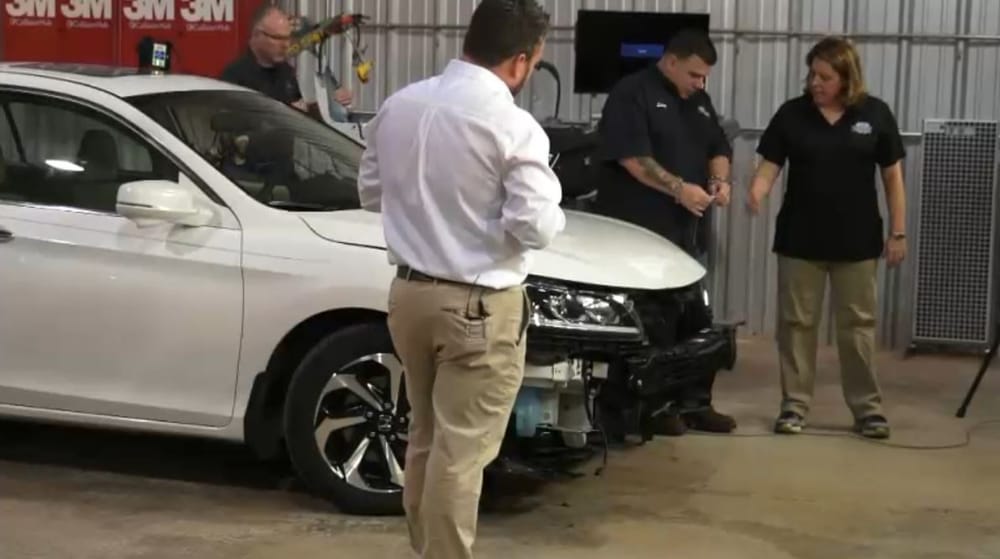
A 2016 Honda Accord repair that fit that description became the subject of a "Repair University Live" episode on Collision Hub, with a panel of experts walking through what they found and what it revealed about the original shop's process.
The repair involved modest initial scope — under $3,000, no red flags in the documentation, a vehicle that left the shop with a customer who had nothing to complain about. What the reinspection found was a string of procedural lapses that individually might seem minor but collectively represent a repair that wasn't done right.
Cleared Fault Codes: A Hiding Problem
Among the first findings in the reinspection: diagnostic trouble codes that had been cleared. Collision Diagnostic Services' operator, who performed the scan using an OEM-capable diagnostics tool through his company's asTech, found that the codes were gone — but the trail of what had been done, and the residual codes that remained, told the story.
"Somebody cleared the faults out," he said.
Kristen Felder, Collision Hub CEO, speculated that the code-clearing was done with an inadequate aftermarket scan tool — the kind available from a tool truck rather than the OEM-level diagnostics that the vehicle's systems required. The problem with using an aftermarket tool on systems requiring OEM-level access is that a successful "clear" on the tool screen doesn't mean the system is actually cleared or calibrated.
This is not a hypothetical risk. A cleared code that isn't genuinely resolved may not trigger a warning light immediately — the condition has to recur, sometimes under specific driving conditions, before the light comes back. In the interim, the vehicle appears to be operating correctly.
Calibration and ADAS: The Overlooked Step
The 2016 Accord is equipped with driver assistance systems — systems that depend on precisely calibrated sensors. A collision that displaces body components, even slightly, can affect sensor alignment. Proper repair requires verifying sensor calibration after any structural or suspension work.
The reinspection revealed that calibration had not been properly addressed. The vehicle had been returned to the customer with systems that needed verification or recalibration post-repair — a step that wasn't in the repair documentation because it wasn't performed.
This is increasingly common in reinspection cases as ADAS becomes standard equipment on mainstream vehicles. The systems are often invisible in a visual inspection; nothing looks wrong, the car drives, the customer reports no issues. The systems are operating in a degraded or uncalibrated state that only becomes apparent when they're actually needed — in a near-miss or an emergency braking scenario.
The Scanning Protocol Problem
The panel used the Accord case to make a broader point about pre- and post-repair scanning. The shop that performed the original repair had not followed a documented scan protocol. No pre-repair scan was in the file, and the post-repair scan — to the extent one was performed — was done with a tool that wasn't appropriate for the vehicle's systems.
This creates a compounding problem: without a pre-repair scan, the shop has no baseline to compare against. Without a proper post-repair scan, the shop cannot document that the vehicle's systems were in the same operational state as prior to the collision. And without documentation, the shop's position in any subsequent dispute is weak.
Basic Process Steps That Were Missed
Beyond the electronics, the reinspection found issues traceable to basic procedural lapses:
- Documentation gaps that made it impossible to verify what was actually done versus what was estimated
- Evidence of panels that had been repainted but not properly prepared
- Measurement records that didn't exist, making it impossible to confirm structural alignment
Each of these individually might be addressed in a supplement or a redo. Together, they form a pattern that the Collision Hub panel described as preventable — not through expensive equipment or advanced training, but through adherence to basic collision repair standard operating procedures.
The Lesson That Scales Beyond One Accord
The Accord case illustrates a dynamic that reinspection specialists frequently encounter: shops that do reasonable work on the visible, testable parts of a repair — the paint, the parts fit, the cosmetic outcome — but skip steps that don't show up in a visual walkthrough.
Pre-repair scans, post-repair scans, calibration verification, and measurement documentation are procedural requirements, not optional enhancements. They exist because modern vehicles depend on them for correct function, and because the shop's liability for the repair extends beyond what the customer can see from the driveway.
"What appeared to be a simple, high-CSI, under-$3,000 auto body repair contained a variety of errors that basic collision repair SOPs would have prevented," the panel concluded. The mechanism for preventing them wasn't sophisticated — it was following the procedure.
For shops evaluating their own processes, the Accord case is a useful template: audit your documentation against what you actually perform on every vehicle, and treat procedural steps that don't generate immediate visible results as just as mandatory as those that do.
