Buying a Frame Bench for Your Collision Shop: An Expert-Backed Decision Guide
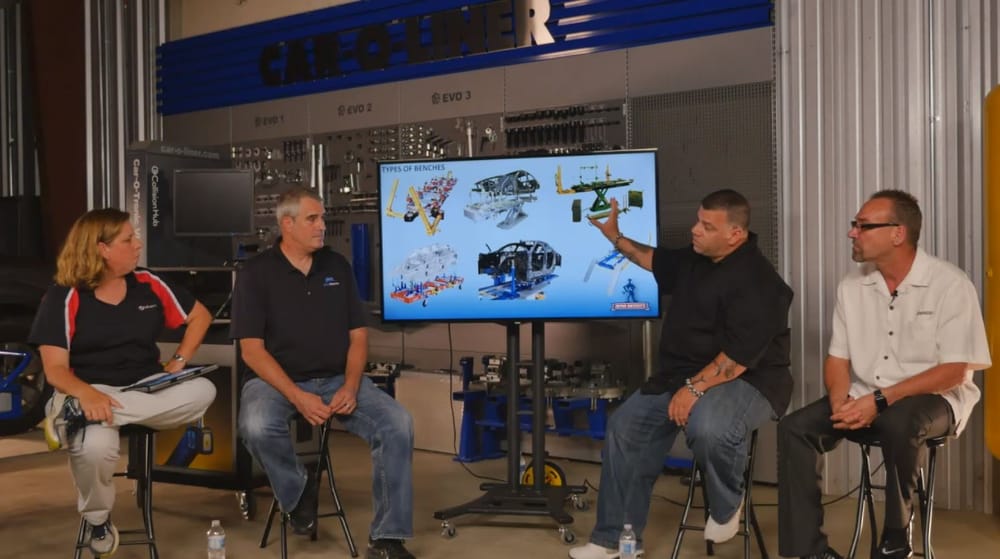
Frame bench selection might be the most consequential equipment decision a collision repair shop makes — and also one of the most frequently done wrong. Too many shops buy on instinct, sentiment, or price without doing the analysis that should drive the decision. The July 2017 "Repair University Live" episode on structural anchoring and measuring offered a thorough discussion of how to approach that decision correctly, featuring Spanesi COO Tim Morgan, P&L Consultants co-owner Larry Montanez, and Vehicle Collision Experts CEO Mark Olson.
Start With Your Vehicle Mix
The fundamental premise: buy the equipment that matches the work coming through your door and the work you want to attract. Everything else flows from that.
Morgan offered a practical example from when the aluminum 2015 Ford F-150 first hit the market. His advice to shops was to pull data from their estimating system and count how many F-150s they had repaired. If the answer was a handful, investing in dedicated F-150 capability before upgrading equipment for higher-volume vehicles might not be the best allocation of capital.
Montanez extended the analysis to local market demographics. In his New York City area, most customers lease — vehicles coming through are relatively new. Further upstate, the repair mix trends older. Market research should reflect your actual geography.
He described a Montana shop that had worked through the analysis carefully. Expected result: lots of pickup trucks, with the 2015-plus F-150 as the primary target upgrade. Actual result: fewer new aluminum trucks than expected, but a disproportionately high number of luxury vehicles — which had to be shipped to Denver because the shop lacked the capability to repair them.
The recommendation: pursue luxury aluminum certification first. That equipment handles the F-150 as well. The reverse isn't true — F-150 capability doesn't necessarily qualify for luxury OEM work.
State DMV data — often available at little or no cost down to zip code level — is a useful starting point. Commercial data from sources like IHS Markit provides more granular vehicle parc analysis for shops that want more detail.
Know What the OEMs Require
Once the vehicle mix is defined, check what the OEMs for those vehicles require in terms of bench systems. This matters even for shops that aren't pursuing formal certification — a shop wanting to follow OEM procedures correctly still needs to know what equipment specifications those procedures reference.
The reality is that OEM requirements don't always align across manufacturers. Some require specific bench brands or systems for particular repair certifications. The result can be a shop that needs multiple bench systems to handle the breadth of its OEM compliance needs.
"You could possibly have five or six systems," Montanez said.
The shop he's affiliated with runs two Car-O-Liners, three Celettes, one Car Bench, and a Globaljig system — a lineup that reflects the multiple OEM programs it supports.
Bench systems aren't interchangeable in their approach. The major categories:
- Universal jig systems (Car Bench, Spanesi, Globaljig): Adaptable to a wide range of vehicles through configurable components
- Dedicated systems (Celette): Vehicle-specific fixtures required for each model; the shop must maintain the specific fixture set
- Hybrid systems (Car-O-Liner): A mix of universal and dedicated approaches
- Pinchweld mounting benches: General-purpose but rapidly becoming obsolete as OEMs prohibit pinchweld mounting due to structural integrity concerns
OEM approval of specific bench systems is not automatic. Morgan described the process Spanesi went through to obtain Porsche, Audi, and Volkswagen approval: factory visits, discussions about upcoming model changes, and years of evaluation. "We see things two to three years in the future," he said.
The Buying Decision Itself
Along with a paint booth, a frame bench is probably the largest capital purchase a collision shop makes. That decision deserves the same business logic applied to any major capital expenditure.
Montanez offered a blunt assessment of shop upgrade cycles: if you haven't bought new equipment in six years, consider it. Fifteen years? "You've been out of touch for a very long time."
Recommendations from the panel:
Choose your vendor as carefully as you choose your bench. Local support — someone who can train your technicians, respond to problems, and provide parts from local inventory — is as important as national availability. Morgan said national programs fail regularly because of inadequate local support. Olson seconded this.
Don't buy used equipment online. Stricter OEM certification programs check serial numbers and inspect equipment condition. A used bench may be damaged, out of specification, or structurally compromised in ways that aren't visible. The bench manufacturer may charge a certification fee to verify used equipment — a fee specifically designed to discourage used purchasing. Morgan noted he could lease a shop a new bench under warranty for less than the cost of a used one from a random seller.
Think about total cost, not purchase price. Under IRS Section 179, shops can deduct up to $500,000 in new equipment purchases, making the economics of new equipment more favorable than they may appear on sticker price alone.
Don't let relationships override business decisions. Felder described colleagues who had purchased inadequate equipment because the salesperson was a friend. Equipment that can't achieve the OEM certification you need isn't a bargain at any price. The value of a frame bench is defined entirely by what work it enables your shop to do properly.
