Mastering OEM Repair Procedures: A Practical Guide for Collision Shops
A $31.5 million jury verdict against a Texas collision shop that ignored Honda repair procedures should be a wake-up call for the industry. But according to P&L Consultants co-owner Larry Montanez, many shops haven't internalized the message. "It hasn't sunk in," he said. Too many repairers are "still going to slap cars together."
That blunt assessment came ahead of Montanez's SEMA presentation, "How to Find, Read and Understand OEM Repair Procedures," part of the SCRS Repairer Driven Education series. The session was designed for shops that are ready to do things correctly — and avoid the kind of legal liability that has become increasingly common.
The Stakes Are Real
The Texas John Eagle Collision Center case made one thing unmistakably clear: plaintiff attorneys like Todd Tracy are paying close attention to the collision repair industry. Montanez cautioned that others would follow Tracy's lead after that high-profile verdict. "All it takes is one Todd Tracy," he said.
That means researching and adhering to OEM repair procedures isn't optional — it's the minimum standard for any shop serious about protecting itself legally and professionally.
OEM Sites Are Learnable — If You Practice
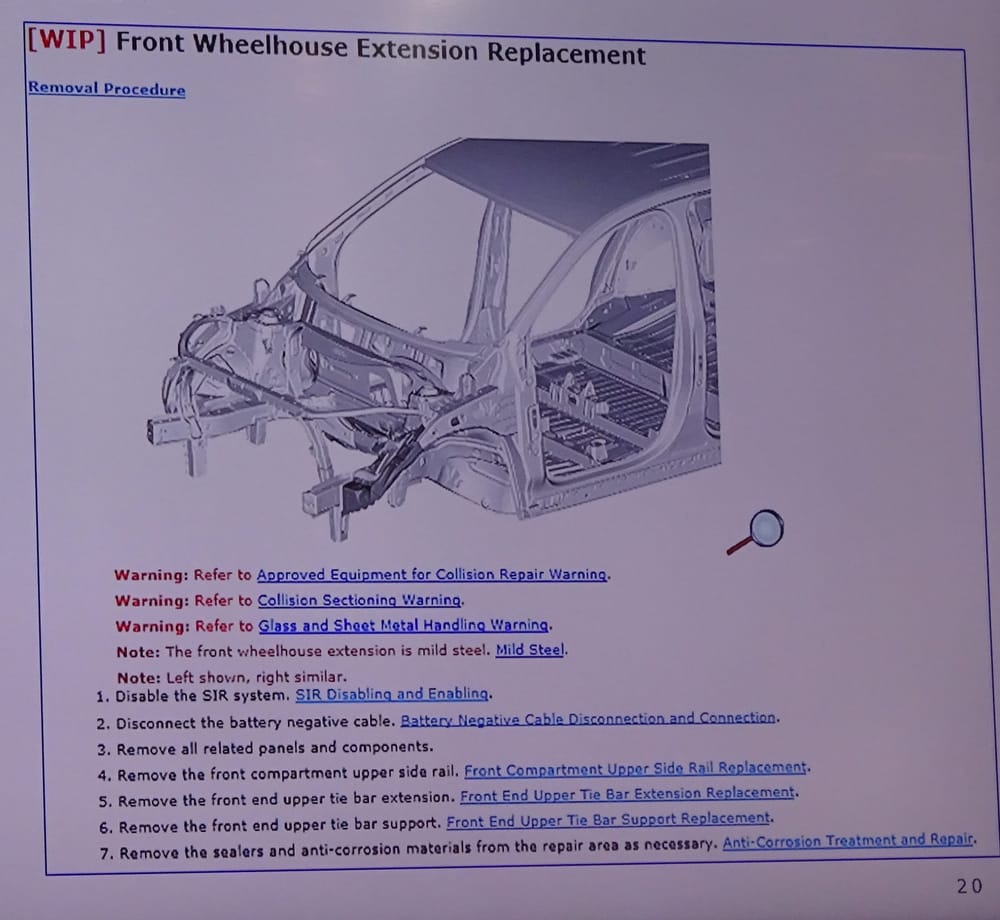
Montanez acknowledged that OEM repair procedure websites can feel overwhelming at first. His advice: approach them the same way you'd learn a new smartphone operating system. You experiment, you explore, you make mistakes, and eventually it clicks. "You screw around with it," he said — and you figure it out.
Flat-rate technicians often resist this investment because they aren't compensated for research time. Montanez was blunt about that attitude: "It's laziness and greed." But for shops committed to proper repairs, this learning curve is a necessary investment.
OEM certification training can accelerate the process. Mercedes-Benz, for example, runs one of the most demanding procedure sites in the industry — but every certification class includes hands-on navigation exercises. After enough repetitions, technicians develop an intuitive feel for the site structure.
Several OEMs with robust certification programs also maintain technical procedure hotlines. When a procedure is unclear or seems to indicate the vehicle should be totaled, shops can call the manufacturer directly. Montanez recalled one case where a German OEM sent a shop a letter from headquarters clarifying exactly how to perform a repair that appeared, at first glance, to require a total loss designation.
Part-by-Part Lookup Strategy
One of the most important habits a technician can develop is looking up procedures for each individual component involved in a repair — not just the primary part being replaced. The manual doesn't always consolidate all relevant steps in one place.
Consider the scenario of replacing a mirror that houses a camera. The instructions for recalibrating that camera won't be in the mirror section — they'll be found under the camera replacement procedures. The technician might not be replacing the camera, but reinitializing it is still required.
This reflects a key difference between mechanical technicians and collision repairers: mechanics generally only replace parts, performing R&I only when a component blocks access. Recalibration and system-reinitialization steps are filed under "replacement" procedures — which is where collision repairers need to look.
Montanez also described a "peel the onion" approach: remove a bumper fascia, find electronic components underneath, and then look those components up individually. Encounter an unfamiliar part number? Google it, find the proper name, and search the repair procedures by that name. Replacing a decklid with an integrated backup camera? Check whether a wheel alignment or camera recalibration is also required.
Occasionally, procedures are in counterintuitive locations — such as BMW's restrictions on reconditioned wheels, which appear in that automaker's refinishing repair procedures, not the structural section.
Use the OEM Source, Not a Knockoff
Despite the availability of third-party aggregators, Montanez firmly advocates going directly to OEM websites. "Why does everyone circumvent the original and go after the knockoff?" he asked. Aggregators may omit content found in the manufacturer's own portals, and integrating an aggregated service into estimating software creates its own risks — a technician logging into an estimating system to check a procedure could accidentally alter or delete the estimate.
His preferred setup: each technician has their own laptop dedicated to accessing OEM sites directly. As a secondary option, a shop could designate a single procedure expert responsible for pulling information for the rest of the team, though he noted that OEM certification programs can require that person to be away for up to two months per year for off-site training.
Browser Compatibility Issues
A practical note for shops dealing with European OEM sites: several of these portals are only compatible with older versions of Internet Explorer — not modern browsers, and not the newest IE versions either. Shops may need to maintain a legacy IE installation with automatic updates disabled. It's inconvenient, but necessary if you want to access the full procedure set for certain German manufacturers.
Painters Are Not Exempt
OEM repair procedures contain guidance for refinish technicians as well. Paint mil thickness tolerances are documented specifically because certain sensors — proximity sensors, radar units — can be thrown off by excessive paint buildup. The German manufacturers typically allow 4.9–5.3 mils; American manufacturers generally permit 6.5–7.2 mils.
Even on surfaces without sensors, Montanez stressed that painters should check OEM procedure documents for thickness tolerances. Porsche's certified pre-owned program, for example, guarantees top resale value after a collision repair — but only when performed by a certified shop operating within specified tolerances. Those tolerances extend to the millionths of an inch on coating thickness. As Montanez put it: "You're talking super thin here."
The Bottom Line
Accessing OEM repair procedures isn't an optional step reserved for high-end vehicles or complex repairs. It's a professional obligation — one that protects the vehicle owner, the shop's reputation, and the business itself from legal exposure. Shops that treat procedure research as overhead, rather than an essential billable task, are operating on borrowed time.
As Montanez's clients have demonstrated: those who put the research cost — both the subscription and the labor hours — on the estimate, and commit to following procedures, get paid for that work. The shops that don't take shortcuts in researching procedures don't have to take shortcuts in defending themselves in court.
