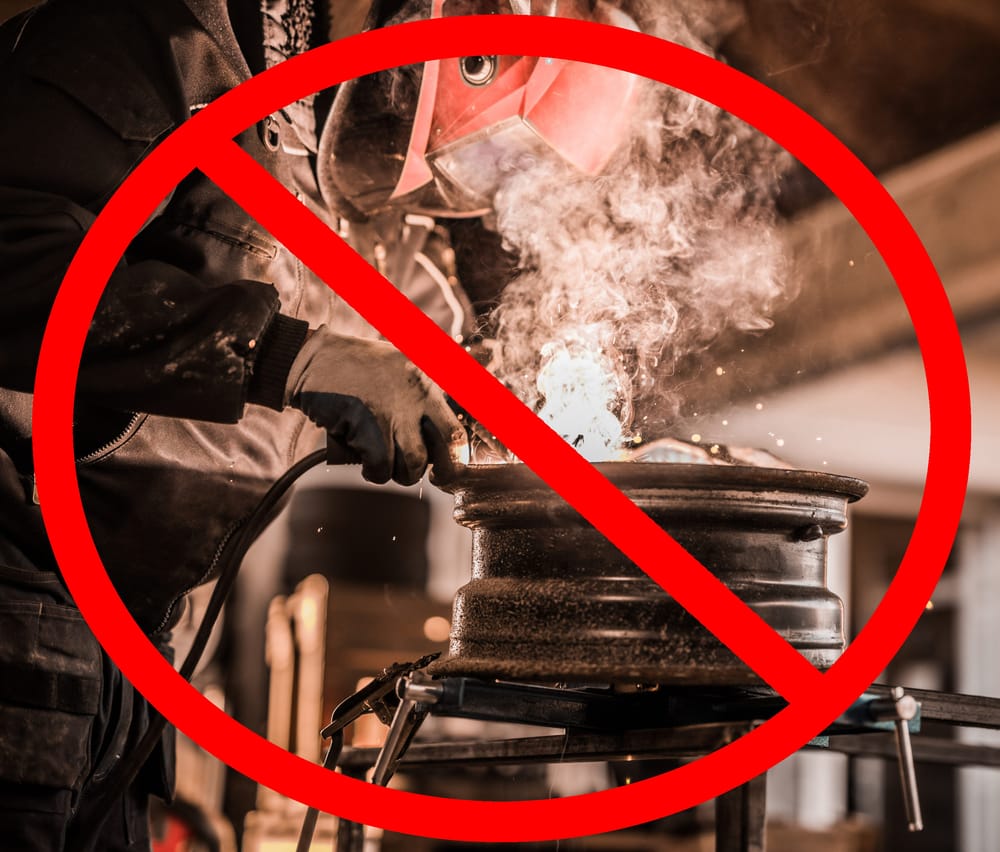
The Wheel Repair Question Has a Clear Answer
Collision repairers may encounter customer requests or insurer pressure to repair a damaged wheel rather than replace it. Before agreeing, shops should understand exactly what OEM position statements say — and it is almost uniformly restrictive.
Collision repair experts speaking during a "Repair University Live" broadcast by Collision Hub, focused on steering and suspension systems, laid out the industry's position clearly: the only wheel-related work that belongs in a collision repair shop is the most cosmetic kind, and even that may be restricted depending on the vehicle manufacturer.
What OEMs Actually Say
The breadth of OEM prohibitions on wheel repair is significant. Many manufacturers have published position statements stating that anything beyond cosmetic correction — removing a scuff, addressing a minor surface scratch — is impermissible. Structural straightening, welding, heating, or material removal beyond surface level are categorically off the table.
The reasoning is straightforward from an engineering perspective. A wheel is a safety-critical component. Its structural integrity depends on the material being in its original manufactured state, with the geometry, stress distribution, and material properties that came from the factory. Once a wheel has been bent, cracked, or subjected to the stress of a collision, those properties are altered in ways that may not be visible but can affect performance under load.
Heat treatment, welding, and straightening can create stress concentrations and microstructural changes in both aluminum and steel wheels. A wheel that looks repaired and passes a visual inspection may still be compromised in ways that only become apparent in a subsequent impact — at which point the failure mode can be catastrophic.
Remanufactured Wheels: Also Off the Table
The panel's guidance extended beyond repair to remanufactured wheels. Remanufactured wheels — those that have been refinished, straightened, or processed by a third party — present the same unknowns as in-shop repairs, with the added issue that the shop cannot verify the repair history or methodology.
Several OEM position statements specifically prohibit the use of remanufactured wheels on their vehicles. Shops that install remanufactured wheels in contravention of OEM guidance are accepting liability for the performance of that wheel in any subsequent incident.
The Cosmetic Exception and Its Limits
The panel acknowledged that truly cosmetic wheel work — addressing surface curb rash that hasn't penetrated to the wheel structure, for example — may be permissible under some OEM guidelines. But this exception is narrower than it might appear.
The key distinction is whether the cosmetic work involves any material removal, heat, or structural alteration. Surface-level refinishing that doesn't compromise the wheel's structural zone may pass OEM review. Any process that goes deeper — grinding out a gouge, bending back a lip, applying heat — does not.
Shops should consult the specific OEM position statement for the vehicle in question before performing any wheel work, not rely on a general assumption that cosmetic work is always permitted. Some manufacturers have restrictions that go beyond what the collision repair community commonly expects.
The Insurer Pressure Problem
The practical challenge for shops is that insurers sometimes push for wheel repair as a cost-saving measure, particularly when the wheel is aluminum and a replacement would be expensive. The shop's professional obligation doesn't change based on the insurer's preference.
If the OEM prohibits the repair, performing it to satisfy an insurer's cost target is not a defensible position if the wheel subsequently fails. The shop performed work on a safety-critical component in a manner specifically prohibited by the manufacturer. That exposure is real.
The correct response is to document the OEM position statement, advise the insurer in writing that the manufacturer prohibits the proposed repair, and request approval for replacement. If the insurer declines, that decision and the insurer's direction needs to be in the file.
What Shops Should Do
The practical guidance from the panel:
- Look up the OEM position statement on wheel repair for the specific vehicle before agreeing to any wheel work beyond basic cosmetic treatment.
- Do not perform straightening, welding, heating, or structural material removal on any wheel regardless of customer or insurer request.
- Do not install remanufactured wheels where the OEM prohibits them.
- Document any disagreement with an insurer who requests non-permissible wheel work.
Wheel repair may seem like a minor line item in the broader context of a collision repair estimate. Its safety implications are not minor.
