Seat Belt Inspection After a Collision: What GM Requires and Why Shops Must Comply
The phrase "four-hour seat belt test" sounds like a punchline — and Collision Hub CEO Kristen Felder used it as one during a "Repair University Live" session. But the underlying message is anything but funny. General Motors requires extensive seat belt inspection and functional testing after any collision, and most collision repair shops aren't performing this work — or billing for it.
That gap between what OEM procedures require and what shops actually do represents both a professional obligation and a legal liability.
The GM Position Statements
Two General Motors position statements — document numbers 2322743 and 2133164 — make the requirement unambiguous. Both date to at least 2014 and apply to any collision, on any GM vehicle, regardless of severity. These aren't recommendations for severe impacts only. They apply after minor collisions where airbags didn't deploy, after low-speed parking lot incidents, and after any other collision that brings a vehicle into the shop.
The requirements aren't limited to physically damaged components. GM's procedure language calls for systematic inspection of the restraint system, with specific steps for each belt in the vehicle, dynamic testing during a road test, and replacement of any component that fails inspection criteria — whether or not it looks damaged.
What the Survey Data Reveals
A "Who Pays for What?" survey focused on seat belt inspections found a troubling pattern: approximately 60 percent of responding shops had never pursued reimbursement for this work. Of shops that did request payment when directed by OEM procedures, only about 31 percent were paid "always" or "most of the time."
Collision Advice CEO Mike Anderson described the absence of billing attempts as "very concerning," concluding that it indicated "too few shops are researching OEM repair procedures and are thus not aware" of the requirements. Some OEMs additionally specify that seat belts worn during a collision must be replaced — and that inspections must include diagnostic scan tool use.
Felder noted she had spent 20 years in auto insurance and had only ever been billed for this inspection at one shop — Montanez's.
The Inspection Process in Detail
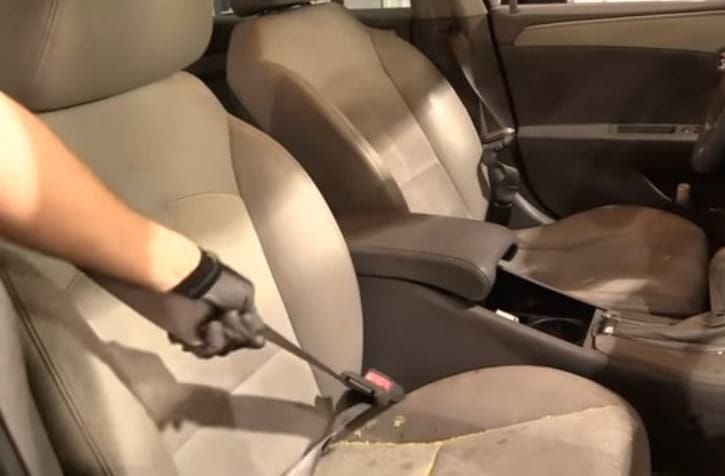
P&L Consultants' Larry Montanez, Vehicle Collision Experts' Mark Olson, and Collision Hub CEO Kristen Felder demonstrated the process on a 2012 Chevrolet Malibu LT that had sustained a pole strike low-speed enough that no airbags deployed.
For the Malibu blueprinting exercise, GM's procedures required checking the following:
Steering column inspection: Even without airbag deployment, the steering column must be inspected for any damage. In many cases, this requires dropping the knee bolster — which may itself contain an airbag, necessitating battery disconnection before work begins.
Instrument panel and knee bolster inspection: The shop must check the instrument panel and knee bolster mounting area for bending, twisting, buckling, or other damage. Some disassembly may be required to inspect properly.
Seat belt functional test (per belt):
- Verify with the ignition on that the belt reminder lamp activates correctly when the belt is buckled and unbuckled
- Confirm the shoulder belt guide swivels freely
- Verify the webbing is fully seated in the guide slot with no binding
- Pull the webbing fully out and check for stretching or other abnormalities
- Inspect both sides of the webbing — not just the outward-facing side. As Montanez noted, the back side of the belt contacts a steel surface during a collision, which can produce burn marks or signs of friction on the nylon. A belt that moves freely but shows heat damage must be replaced.
- Verify the buckle faces inboard and is accessible
- Confirm retractor units are securely attached and anchor bolts are secure
- Allow webbing to retract and verify it retracts smoothly
- Buckle the belt and deliver a firm tug to test latch security
- Press the release button and verify it returns to initial position
This process is repeated for every belt in the vehicle, including any center rear seat positions, which have their own additional GM inspection steps.
Dynamic road test: The inspection isn't complete without a test drive. GM requires a road test with a passenger on an unoccupied stretch of road. The driver accelerates to 10 mph and applies the brakes firmly to verify that every belt locks properly. If a belt fails to lock, the retractor must be R&I'd, tilted to a specified angle, and retested.
For the Malibu on the show, the driver's belt had already locked up and couldn't be buckled — it needed to be replaced because of the tensioner.
The Child Safety Seat Factor
A detail that both shops and customers frequently overlook: child safety seats must also be replaced following a collision. All major manufacturers specify this.
A child seat that was in the vehicle during a collision may not be in the shop — the customer often installs it in their rental vehicle. The shop has an obligation to advise the customer that any child safety seat involved in or present during the collision should be replaced. The customer may be driving with a potentially unsafe seat without knowing it.
The $8.5 Million Reason to Take This Seriously
Mark Olson recounted a case study that makes the stakes concrete. A shop settled for $8.5 million after failing to perform restraint inspections on a vehicle that had been backed into by a truck while parked and unoccupied. A subsequent collision involving the same vehicle left occupants paralyzed.
The vehicle wasn't visibly damaged in a way that suggested extensive restraint system damage. But the inspection requirements existed regardless — and the shop's failure to perform or document them was central to the litigation.
Billing and Documentation
Shops do not have to charge customers for every inspection step. But Felder was clear on the professional obligation: "You cannot make a business decision for choosing not to do something."
Her recommendation: document every step of the inspection process on the estimate regardless of whether the shop charges for the work. That documentation creates a record that the work was completed and protects the shop in the event of a future claim.
The operations involved are not included in standard estimating times. They must be manually added to the estimate, documented with specificity, and performed consistently — not only when the shop thinks the collision was severe enough to warrant it, but whenever GM's procedures say so. Which, per the position statements, is after any collision.
