When a Budget Sedan Needs a Luxury Repair: The New Chevy Cruze Procedure Reality
It used to be safe to assume that exotic repair procedures — MIG brazing, structural rivets, panel adhesive — were the province of European luxury vehicles. That assumption is no longer valid, and the 2016 Chevrolet Cruze is the example that makes the point most effectively.
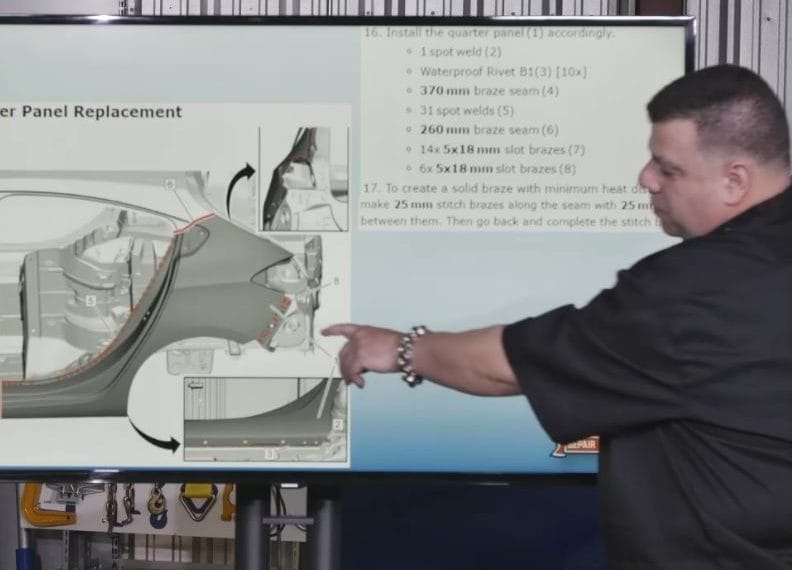
During an April 2017 "Repair University Live" broadcast on Collision Hub, P&L Consultants co-owner Larry Montanez, Collision Hub CEO Kristen Felder, and I-CAR industry technical relations director Jason Bartanen compared the OEM quarter panel replacement procedures for the 2015 and 2016 Cruze generations side by side. The difference was dramatic.
What Changed Between 2015 and 2016
The 2016 Chevrolet Cruze represented a full redesign from its predecessor. General Motors engineered approximately 250 pounds of weight out of the vehicle compared to the 2015 model, partly through the use of high-strength and hot-stamped steels. The result was a body structure roughly 27 percent stiffer while being 53 pounds lighter.
All of that structural engineering shows up in the repair procedures.
The 2015 Cruze's quarter panel replacement was conventional: MAG welding, plug welds, standard body procedures.
The 2016 Cruze's quarter panel replacement involves:
- MIG brazing
- Spot welds
- Structural rivets
- Panel bonding adhesive
"This is very similar to a Mercedes-Benz repair procedure," Montanez said, specifically referencing steel Mercedes models across the C, E, and S Classes.
Felder's reaction: "dramatically different."
The Equipment Reality
MIG brazing and riveting aren't performed with the same equipment as conventional MAG welding. Shops that repaired 2015 Cruzes without issue may not have the tools necessary to properly repair a 2016 model.
Montanez made the cost implication explicit: between the MIG brazing welder and a proper rivet gun, "it's more money than the car, basically." That's not a complaint — it's a description of the capital investment that proper modern collision repair requires.
I-CAR's Bartanen noted the absence of conventional MAG and plug welding on the new Cruze as a procedural marker. This isn't a matter of preference or approach. The OEM procedures are what they are, and they require specific joining methods that demand specific equipment and training.
Implications for Estimators and Adjusters
Felder made clear that the procedural complexity affects the estimating side of the business just as much as the technical side. When a panel replacement involves multiple joining methods, each attachment method carries its own setup time, test time, and material cost.
The MIG brazing welder setup, rivet gun setup, adhesive application and cure time — all of it must be accounted for in the estimate. The estimator cannot simply treat a 2016 Cruze quarter panel as functionally equivalent to a 2015 model because the sheet metal looks similar.
"I love it when I hear someone say, 'It's just a quarter panel, Kristen,'" Felder said.
The rivets, adhesive, and multiple weld types are each line items. Setup and testing time for the multiple processes is a not-included operation the estimator needs to add manually. And the technician performing the work needs training on the specific methods the OEM requires.
The Broader Point
General Motors sold nearly 189,000 Cruzes in 2016. This is not a niche vehicle. It's a high-volume mainstream sedan with repair procedures that closely resemble those for a high-end European luxury car.
Shops that assume complexity is limited to premium brands are already behind. And shops that haven't evaluated their equipment inventory against the repair requirements of the vehicles coming through their doors are taking on liability they may not have accounted for.
The 2016 Cruze case is useful precisely because of what it represents: an affordable, common, everyday vehicle that demands uncommon repair capabilities. The pattern is consistent across the industry. Every model year cycle brings more advanced materials, more sophisticated joining methods, and more complex procedures into vehicles at every price point.
Knowing what OEM procedures require — and having the equipment and training to follow them — isn't a specialty capability anymore. It's baseline collision repair.
