The Science That Closes the Door on Used Quarter Panels
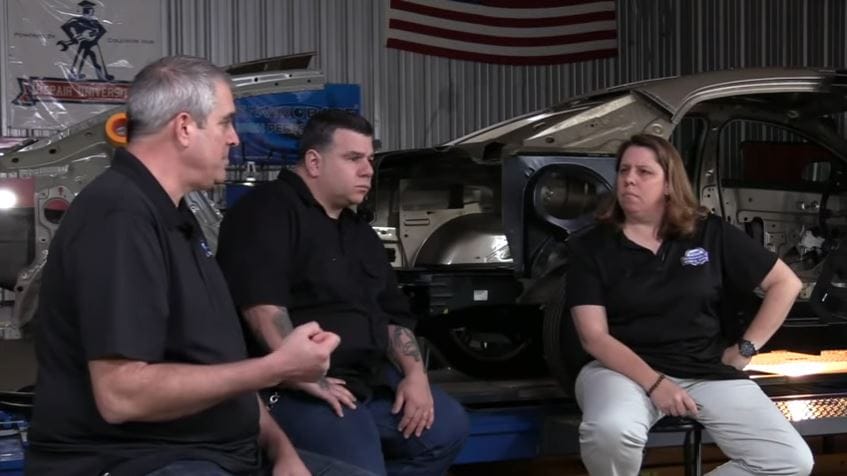
When it comes to used quarter panels, the debate isn't really about cost or availability — it's about physics. Heat, metallurgy, and weld geometry combine to make used quarter panel installation a technically indefensible choice on modern vehicles. A panel of collision repair experts broke down the reasoning during a Collision Hub "Repair University Live" broadcast, and the science is hard to argue with.
Collision Hub CEO Kristen Felder opened the discussion with a principle that applies broadly: shops need to understand not just what the OEM says but why. Understanding the underlying reasoning makes it possible to evaluate edge cases intelligently — and to explain decisions to customers and insurers.
The Heat Problem
The foundational issue with used quarter panels is heat. On vehicles built with advanced high-strength steel (AHSS) or other metals beyond mild steel, heat during welding is tightly constrained because it changes the material properties of the metal.
When heat is applied to AHSS during a weld, the affected zone can lose its strength characteristics — exactly the properties that make the steel valuable in the first place. A used quarter panel from a salvage yard carries an unknown thermal history. You don't know if it's been in a previous collision. You don't know what repairs were done, or whether it was exposed to heat during prior cutting or welding. That uncertainty alone disqualifies it for structural reinstallation.
MAG Welding Diameter Constraints
P&L Consultants co-owner Larry Montanez walked through a specific technical constraint that many shops don't fully appreciate: OEM procedures for MAG plug welding specify a maximum hole diameter — often 8 mm on outer panels. The concern is not just the hole itself but how far the weld heat spreads beyond it.
An 8 mm plug weld might expand to a 14 mm heat-affected zone. That expansion matters when the OEM's structural calculations assume the surrounding metal retains its original strength. On a used quarter panel, the weld area's prior history is unknown, and any previous heat exposure can cause microstructural changes that weaken the metal even before the new weld is applied.
This is why OEMs specify not just weld type and diameter but the precise sequence and spacing of welds — the thermal management built into those procedures isn't arbitrary.
The Aluminum Consideration
The heat issue extends into aluminum, which is increasingly used for exterior panels and structural components. Aluminum is sensitive to heat in ways that are sometimes misunderstood. The metal work-hardens during forming and loses that hardness when reheated — a process that can't be reversed without controlled heat treatment.
More practically, aluminum panels carry concerns about galvanic corrosion when worked near steel. A used aluminum panel from a salvage yard may have been subjected to improper handling, contamination, or prior repairs that introduce galvanic pathways invisible to the naked eye.
The Estimating Problem
Beyond the weld and material issues, Montanez pointed out a pre-repair estimation challenge: shops frequently fail to account for all the work genuinely required to install a quarter panel properly. The estimate must reflect the actual operation, not a shortcut version.
OEMs allow MAG plug welding in specific circumstances, but those circumstances come with conditions. The weld count, placement, diameter, and sequence are specified. If the shop's approach deviates from the OEM procedure because they're working with a used part of unknown geometry or history, the deviation has to be documented and justified — and in most cases, the OEM simply prohibits it.
What the Alternatives Look Like
For shops accustomed to sourcing used panels to control costs, the practical alternative is a genuine conversation about repair scope. OEM procedures often call for sectioning rather than full quarter panel replacement. When full replacement is required, the part must be new — ideally OEM or a certified quality-equivalent — with full traceability.
Felder noted that this conversation with estimators needs to happen at the vehicle level, not the parts-cost level. The question isn't "can we save money on this panel?" The question is "what does this vehicle's OEM repair procedure require, and can we meet those requirements with the part we're proposing?"
The slide used in the Collision Hub broadcast illustrating the estimating considerations made the point visually: the factors that determine whether a repair is safe and correct exist well upstream of the actual work. Getting the estimate right is the first technical decision in the repair process.
The Liability Dimension
Shops that install used quarter panels on vehicles where OEM procedures prohibit or restrict them carry the liability. If the vehicle is later involved in another collision and the structure performs worse than it should because of a compromised weld area or a part with an unknown thermal history, the shop that performed the repair is exposed.
That exposure is not theoretical. As vehicles become more dependent on integrated structural design for occupant protection, the difference between a correct repair and a cost-optimized one carries real consequences in terms of crash performance. The industry consensus on this point is not nuanced: follow the OEM procedure, use the specified part type, and document everything.
