Feather, Prime, and Block: The Refinishing Gap Estimating Systems Miss
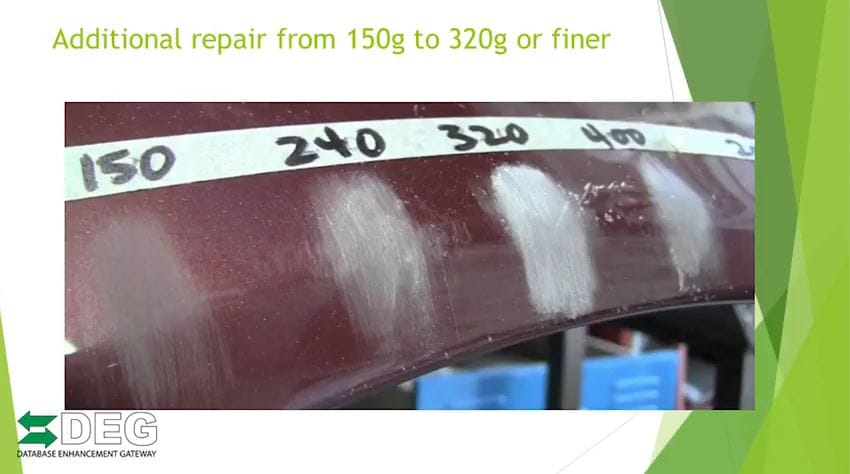
Most collision repair estimating systems stop at 150 grit — but so does a lot of actual shop work. The problem? A part at 150 grit isn't ready for primer, let alone paint. That gap between 150-grit prep and paint-ready surfaces is where the feather, prime, and block operation lives, and it's a procedure that remains widely underpaid and misunderstood across the industry.
Database Enhancement Gateway (DEG) Administrator Danny Gredinberg brought this issue front and center during his presentation at the April 2018 SCRS open board meeting in Denver — a session later released as a video on the Society of Collision Repair Specialists' YouTube channel.
What Happens Without Feather, Prime, and Block?
Gredinberg, a former certified luxury technician, explained that surface imperfections remaining at 150 grit don't simply stay hidden. As a vehicle sits in the sun, heat causes paint and filler materials to shrink and contract into those microscopic scratches, making sand scratch swelling a visible — and avoidable — defect.
"There's a gap," he said, describing the space between what estimating systems include and what a quality repair actually requires.
That gap is the feather, prime, and block sequence. It's the refinishing work that bridges rough substrate prep and the smooth, paint-ready surface a quality paint job demands.
Where the Estimating Systems Stand
CCC and Mitchell do not include feather, prime, and block in their labor times. Audatex includes the work only for replacement welded panels. Every other scenario — which covers a substantial portion of day-to-day repair work — leaves shops in the position of manually adding the operation or absorbing the cost.
Gredinberg is clear that this is a refinish operation. It requires a qualified person, must be performed in an enclosed environment, and typically falls under EPA Rule 6H jurisdiction — meaning in most cases, only a licensed painter can apply the primer involved.
The result is a labor operation that demands skill, time, compliance with environmental regulations, and dedicated shop space — none of which should be performed for free.
The DEG as an Industry Resource
The Database Enhancement Gateway exists to bridge exactly these kinds of knowledge and compensation gaps. As a free resource serving both insurers and repairers, the DEG facilitates inquiries to the major estimating information providers — CCC, Mitchell, and Audatex — when questions arise about what's included in a labor time and what isn't.
At the time of Gredinberg's presentation, the DEG had processed more than 12,000 such inquiries. The organization is funded by sponsors including PPG, the Alliance of Automotive Service Providers, the Automotive Service Association, SCRS, and — as of 2018 — Spanesi Americas, which joined as the DEG's second private-sector Gold sponsor.
Timothy Morgan, Spanesi Americas managing director and COO, described the DEG as "a much needed service to our industry that bridges the information gap between collision repair facilities and information providers." Gredinberg echoed the sentiment, noting that Spanesi's support of the resource was recognition of its impact on the damage documentation process.
'Who Pays?' Survey Integration
Gredinberg's DEG presentation was one of two videos released from the April 2018 SCRS open meeting. The second featured CRASH Network editor John Yoswick presenting on the "Who Pays for What?" quarterly surveys, which track shop success rates in collecting reimbursement from the top eight U.S. insurers for not-included operations.
Going forward, the DEG committed to providing real-world inquiry examples linked to each procedure covered in the "Who Pays?" reports. That integration creates a more complete picture: survey data showing whether shops are getting paid, combined with concrete DEG inquiry language that shops can reference when fighting for reimbursement.
For collision repairers, the message is consistent: feather, prime, and block is legitimate, billable work. Document it. Ask for it. Use the DEG to back it up.
Take Action
Body shops looking to flag database issues or submit inquiries about not-included operations can do so for free at degweb.org. The "Who Pays for What?" survey results are available at crashnetwork.com. Both are valuable, underused tools for shops trying to get paid accurately for the work they perform.
